









- Your cart is empty Browse Shop
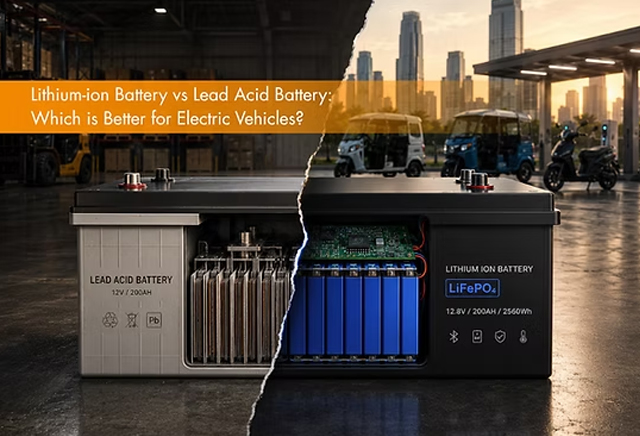
When people evaluate an electric vehicle, they often focus on its range, charging time, or price. But the real difference between a good EV and a great one lies beneath the surface, the battery that powers it.
For decades, lead acid batteries were the go-to choice for electric mobility because they were affordable, readily available, and easy to manufacture. But as EV technology has evolved, so have the expectations from a battery. Today’s vehicles are expected to travel farther, charge faster, last longer, and require minimal maintenance.
That’s why lithium-ion batteries have become the preferred technology for modern electric vehicles.
Does that mean lead acid batteries are obsolete? Not entirely.
Both battery technologies have their place, and understanding their strengths and limitations is essential before making a decision. When evaluating Lithium-ion Battery vs Lead Acid Battery, factors such as performance, lifespan, charging speed, and total ownership cost play a crucial role. In this article, we’ll compare lithium-ion and lead acid batteries across performance, lifespan, charging, cost, and real-world applications to understand which technology is better suited for today’s electric mobility.
To better understand the Lithium-ion Battery vs Lead Acid Battery debate, it is important to first examine how each technology works and where it performs best.
Lead Acid Batteries: The Technology That Started It All
Long before electric cars became mainstream, lead acid batteries had already established themselves as one of the world’s most reliable rechargeable battery technologies.
Known for their affordability and simple construction, they continue to power automotive starter batteries, backup power systems, forklifts, and some low-speed electric vehicles.
Their biggest advantage is cost. For applications where budget matters more than performance, lead acid batteries remain a practical choice.
However, electric vehicles demand much more than affordability. Frequent charging, higher driving ranges, lighter vehicles, and longer operating life have exposed the limitations of lead acid technology.
Advantages
- Lower upfront cost
- Proven and widely available technology
- Highly recyclable
- Suitable for stationary and low-speed applications
Limitations
- Heavy and bulky
- Lower energy density
- Longer charging time
- Shorter service life
- Regular maintenance (for flooded batteries)
- Reduced efficiency during repeated deep discharges
One of the most significant differences in the Lithium-ion Battery vs Lead Acid Battery comparison is how each technology meets the demands of modern electric mobility.
Why Lithium-ion Has Become the EV Industry Standard
Modern electric vehicles place far greater demands on a battery than ever before. It must store more energy, charge quickly, operate safely, and deliver consistent performance over thousands of charging cycles.
This is exactly where lithium-ion technology stands apart.
Unlike lead acid batteries, lithium-ion batteries pack significantly more energy into a smaller and lighter footprint. That means better driving range, faster charging, improved vehicle performance, and lower maintenance throughout the battery’s lifetime.
Today, lithium-ion batteries power everything from electric scooters and three-wheelers to passenger cars, buses, commercial fleets, and energy storage systems.
Key Advantages
- High energy density
- Lightweight construction
- Faster charging
- Longer battery life
- Minimal maintenance
- Higher energy efficiency
- Better overall vehicle performance
Despite a higher purchase cost initially, the value delivered through longer service life and efficiency can provide better returns in the long run.
Bigger Batteries Aren't Always Better
One of the biggest misconceptions in commercial electric mobility is that a larger battery automatically delivers better value.
While higher-capacity batteries can provide longer operating range, they also increase vehicle cost, add weight, and may remain underutilised throughout their service life.
A battery that’s larger than the application’s actual requirement often results in unnecessary capital investment without significantly improving productivity.
The most efficient commercial EV isn’t necessarily the one with the biggest battery.
Real-World Applications: Why One Size Doesn't Fit All
Passenger Three-Wheeler
A passenger electric three-wheeler operates approximately 70 kilometres each day and returns to a charging station during scheduled breaks.
In this case, selecting the largest available battery may only increase vehicle cost without providing meaningful operational benefits. A properly sized lithium-ion battery comfortably supports daily operations while improving efficiency and reducing upfront investment.
Logistics Fleet Vehicle
A cargo vehicle covers more than 180 kilometres every day across multiple delivery routes without returning to the depot.
Here, a larger battery becomes essential because uninterrupted operations are more valuable than the additional battery investment.
These examples highlight an important principle: battery capacity should always be matched to the application’s energy requirements rather than following a one-size-fits-all approach.
Why Battery Chemistry and BMS Matter?
Battery capacity alone doesn’t determine how efficiently a commercial EV performs.
Battery chemistry and the Battery Management System (BMS) play an equally important role. Together, they determine how safely, efficiently, and reliably a battery performs throughout its lifecycle.
Today, many commercial EVs use Lithium Iron Phosphate (LFP) batteries because they offer excellent thermal stability, longer cycle life, enhanced safety, and reliable performance under demanding operating conditions. These characteristics make LFP technology particularly well suited for commercial mobility applications.
An intelligent Battery Management System continuously monitors battery health, cell balancing, voltage, and temperature while protecting the battery against unsafe operating conditions. This helps maximise usable energy, improve safety, and extend battery lifespan.
In simple terms, a well-engineered battery isn’t defined only by its capacity, it’s defined by how effectively that capacity is managed.
How Neuron Energy Approaches Battery Selection?
At Neuron Energy, we believe battery selection should begin with understanding the application, not simply comparing specifications.
Every commercial EV operates differently. Factors such as daily distance, payload, route conditions, charging availability, and operating environment all influence the ideal battery configuration.
Our lithium-ion battery solutions combine advanced Lithium Iron Phosphate (LFP) chemistry with intelligent Battery Management Systems, robust thermal protection, and application-specific engineering.
The result is consistent performance, enhanced safety, and long service life across electric two-wheelers, three-wheelers, e-tractors, industrial vehicles, and energy storage applications.
Because the right battery doesn’t just power a vehicle, it powers the business behind it.
Final Thoughts
Choosing the right battery capacity isn’t about selecting the largest battery available. It’s about selecting the battery that best supports the way a commercial vehicle operates every day.
By evaluating daily distance, payload, charging infrastructure, operating conditions, and future business requirements, businesses can improve vehicle uptime, reduce operating costs, and maximize Total Cost of Ownership.
As commercial electric mobility continues to expand, battery capacity will remain one of the most important decisions influencing fleet performance and profitability.
The right battery isn’t measured only in kilowatt-hours. It’s measured by the reliability, efficiency, and business value it delivers throughout its lifecycle.